
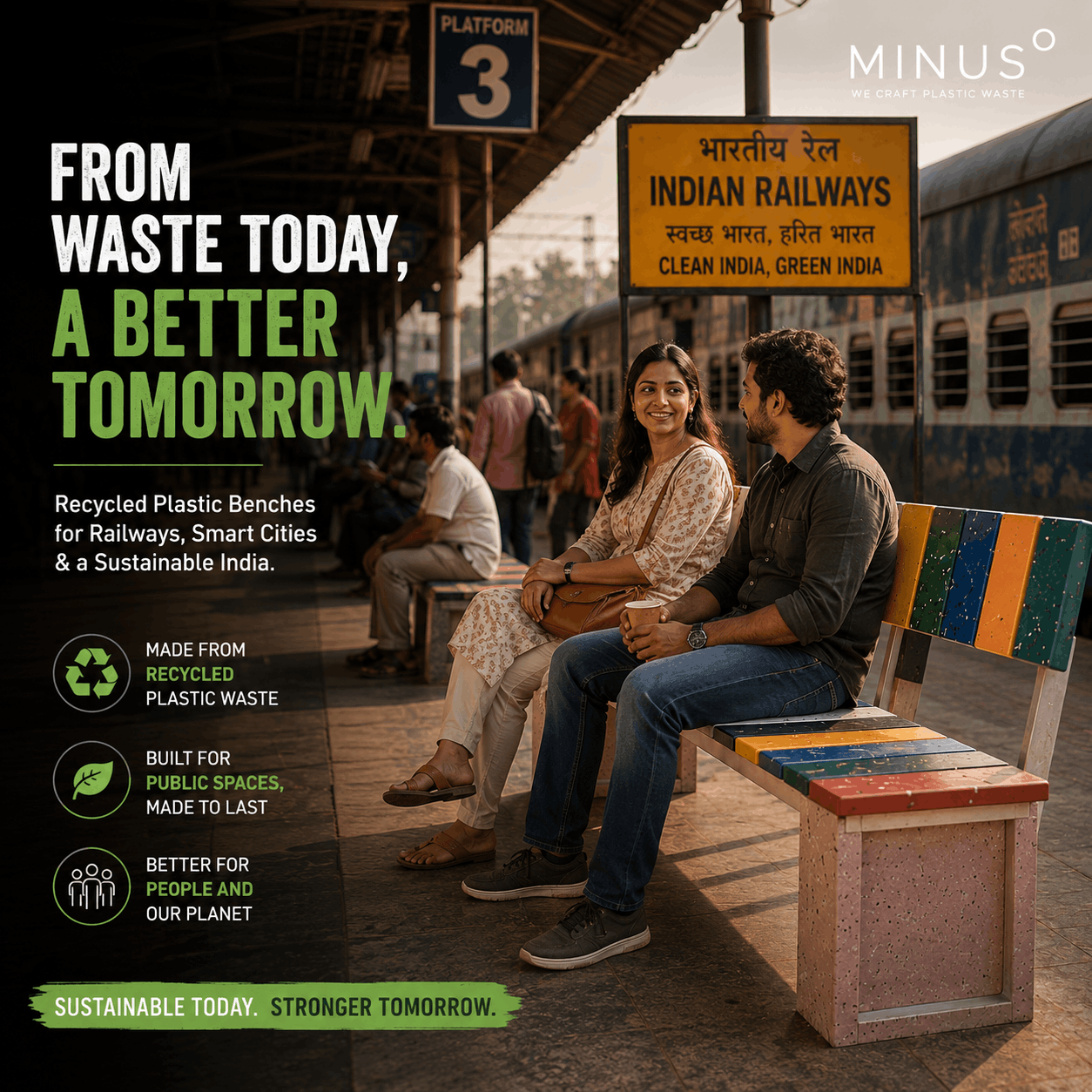
India is not just building more infrastructure. It is beginning to rethink what that infrastructure should be made from.
Airports are expanding. Railway stations are being redeveloped. Metro networks are growing. Smart-city projects are reshaping public spaces. Corporates are investing in ESG and CSR infrastructure.
And across all of these environments, one simple product appears again and again:
the public bench.
Traditionally, public seating has been manufactured from wood, steel, concrete, or virgin plastic.
But a new generation of infrastructure is asking a different question:
Can yesterday’s waste become tomorrow’s infrastructure?
The answer is increasingly yes.
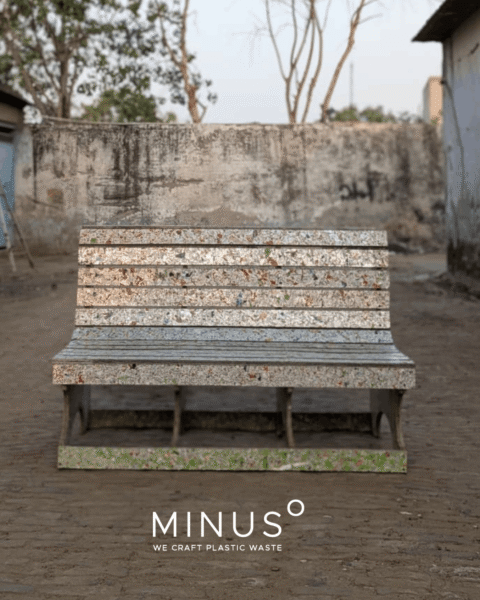
Recycled plastic is moving from waste-management facilities into airports, railway stations, parks, campuses, public spaces and smart-city infrastructure.
For Minus Degre, this is not a theoretical concept.
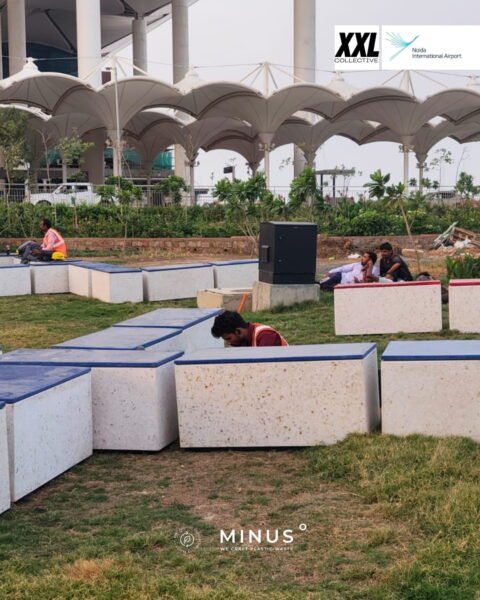
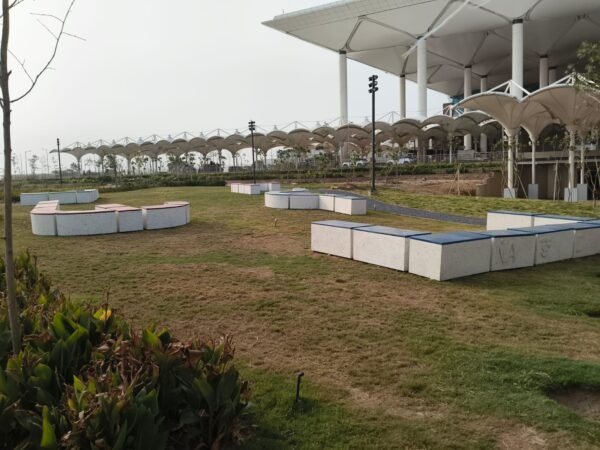
The company has developed recycled-material seating for real public infrastructure, including 90+ custom seating modules at Noida International Airport, manufactured from recycled polycarbonate waste. The project demonstrates that difficult plastic waste can be converted into engineered, design-led infrastructure for a demanding public environment.
And the opportunity goes much further than one airport.
Why Recycled Plastic Benches Are Becoming Infrastructure
A public bench is exposed to conditions that ordinary furniture rarely experiences.
It may face:
- Continuous human usage
- UV radiation
- Rain and humidity
- Dust and pollution
- High temperatures
- Repeated loading
- Cleaning chemicals
- Vandalism
- Frequent movement and impact
- Long periods without maintenance
Therefore, the real question is not:
“Is recycled plastic sustainable?”
The real question is:
“Can recycled plastic perform reliably enough to become infrastructure?”
That is the engineering challenge.
And that is where the conversation around recycled benches needs to mature.
A recycled bench should not be purchased simply because it contains recycled material.
It should be evaluated on:
material composition + structural performance + weather resistance + durability + maintenance + lifecycle + manufacturability.
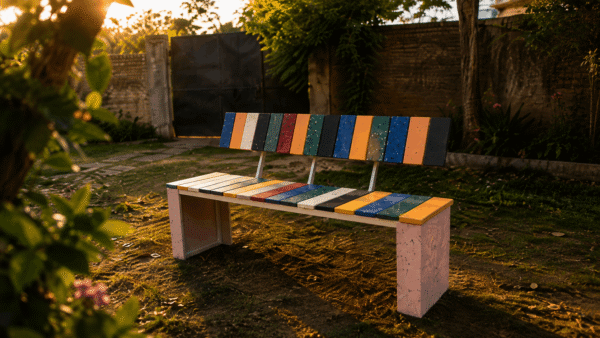
The Engineering Behind a Recycled Plastic Bench
Not all recycled plastics are the same.
A bench manufactured from recycled polycarbonate is fundamentally different from one manufactured from recycled HDPE, PP, PVC or mixed plastic waste.
The material therefore has to be selected according to the application.
For architects and procurement teams, the technical specification should include at least the following parameters.
1. Tensile Strength
Tensile strength indicates the material’s ability to resist being pulled apart under load.
For engineering-grade polycarbonate, typical virgin-material tensile-strength values are commonly in the 50–70 MPa range, depending on grade and testing standard.
For recycled material, however, the actual value can vary significantly based on:
- Polymer type
- Recycled content
- Contamination
- Processing temperature
- Additives
- Fibre reinforcement
- Processing history
Therefore, the final recycled material should be tested rather than assuming virgin-polymer specifications.
For an infrastructure project, the manufacturer should ideally provide a project-specific material datasheet and relevant test report.
2. Impact Resistance
Public seating experiences far more than static loading.
People sit, stand, lean, jump, drag luggage against it and occasionally impact the structure.
For this reason, impact resistance can be as important as tensile strength.
Engineering plastics such as polycarbonate are particularly interesting for public infrastructure because of their inherent impact resistance.
At Noida International Airport, Minus Degre used recycled polycarbonate waste for more than 90 seating modules specifically developed for a high-traffic public environment.
3. UV Resistance
Outdoor furniture is exposed to sunlight for years.
UV exposure can cause:
- Colour fading
- Surface degradation
- Embrittlement
- Loss of mechanical performance
Therefore, “weather-resistant” should not be treated as a vague marketing statement.
For outdoor procurement, the manufacturer should specify the UV-stabilisation approach and, wherever required, provide accelerated-weathering test results under an applicable standard.
For long-term projects, buyers should ask:
How was UV performance tested, for how many hours, and against which standard?
That is a much better question than simply asking whether a bench is “UV resistant.”
Expected Service Life: Recycled Plastic vs Wood and Metal
Service life depends on material formulation, design, loading, installation and environment.
A realistic procurement document should therefore avoid promising a universal lifespan.
As an indicative benchmark, properly designed recycled-plastic outdoor furniture can target 10–20+ years of service, depending on material and application. Minus Degre’s published recycled-bench information currently cites outdoor lifespans in the 10–15 year range, while its broader product information describes some benches as capable of lasting 20 years or more.
For comparison:
| Parameter | Wood | Painted/Coated Metal | Recycled Plastic |
|---|---|---|---|
| Water exposure | Requires protection | Can corrode depending on system | Generally highly water resistant |
| Termites | Potential issue | No | No |
| Rust | No | Potential issue | No |
| Painting | Often required | Often required | Usually lower requirement |
| Splintering | Possible | No | No |
| UV exposure | Can weather/crack | Coating may degrade | Material-specific |
| Maintenance | Medium–high | Medium | Generally low |
| Indicative outdoor life | Highly variable | Highly variable | ~10–20+ years depending on system |
| Recycled content | Usually low/none | Variable | High potential |
| Circularity | Depends on sourcing | High recyclability | Can directly utilise plastic waste |
The important distinction: recycled plastic is not automatically better than every wood or metal product.
The advantage emerges when the material is correctly engineered for the intended environment and evaluated across its full lifecycle.
How Much Plastic Can One Bench Recycle?
This is one of the most important questions for CSR teams and sustainability departments.
A recycled bench can become a measurable waste-diversion asset.
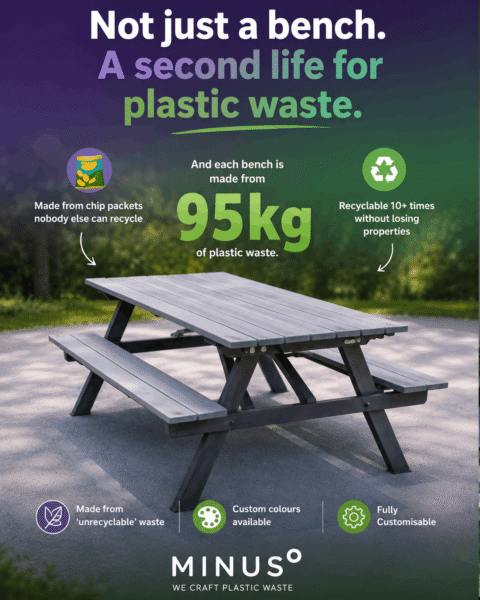
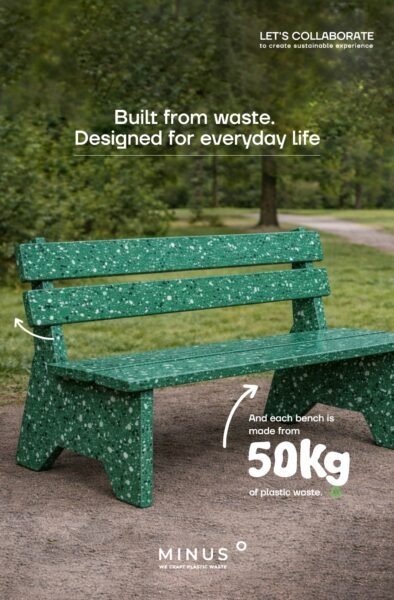
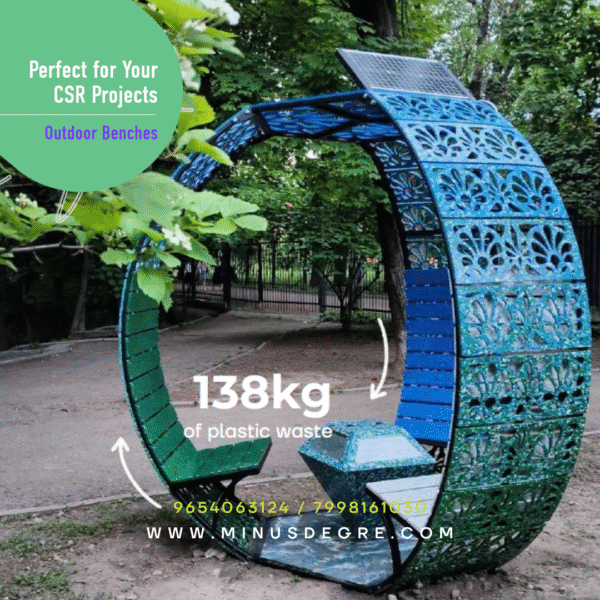
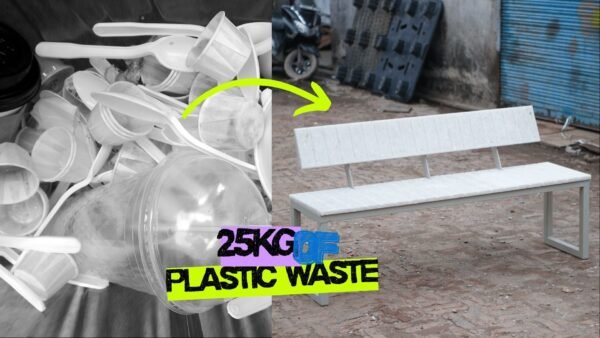
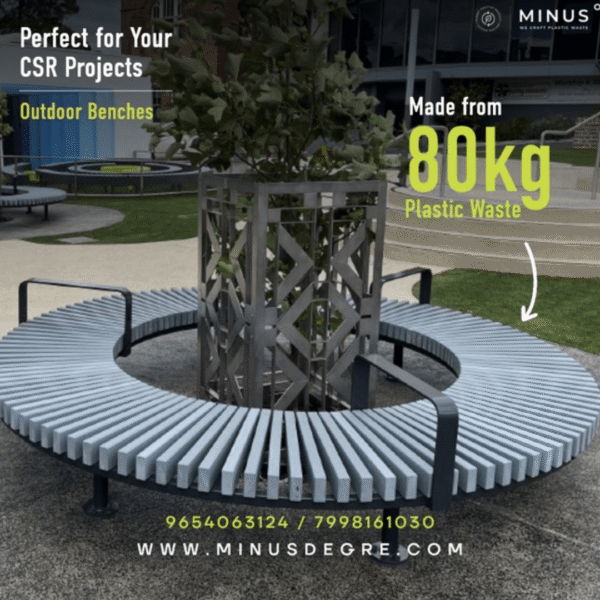
Depending on design, material and dimensions, Minus Degre’s published recycled benches typically use approximately 50–80 kg of plastic waste per bench.
That means a project containing:
100 benches × 50 kg = 5 tonnes of recycled plastic
At:
500 benches × 60 kg = 30 tonnes
And at:
1,000 benches × 70 kg = 70 tonnes
The numbers quickly become significant.
This is why public furniture can be an effective bridge between waste management and visible infrastructure.
The Noida International Airport Case Study
One of the strongest examples of recycled public seating entering mainstream infrastructure is the Minus Degre project at Noida International Airport.
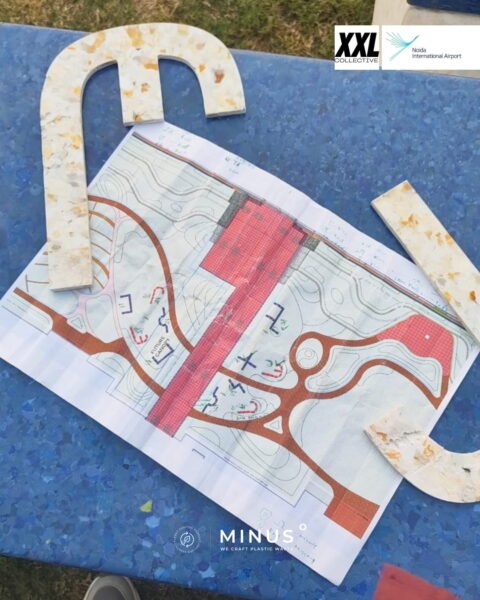
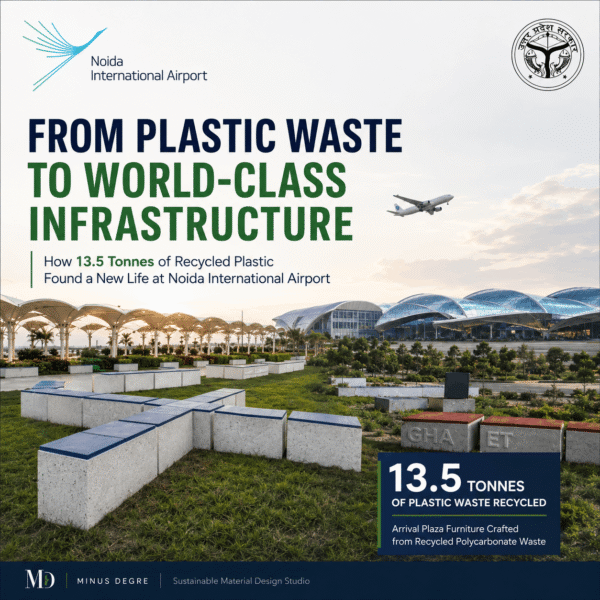
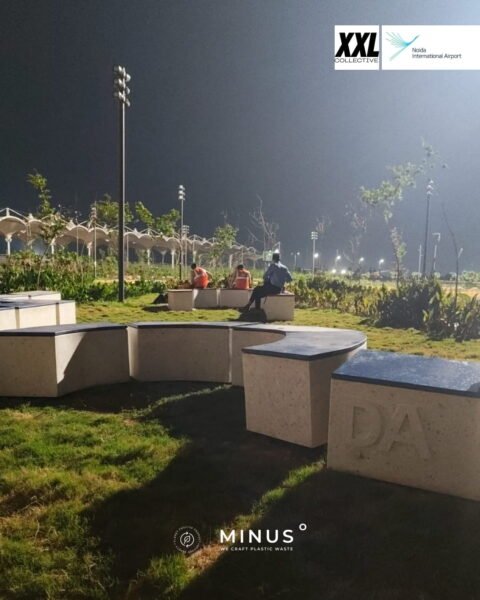
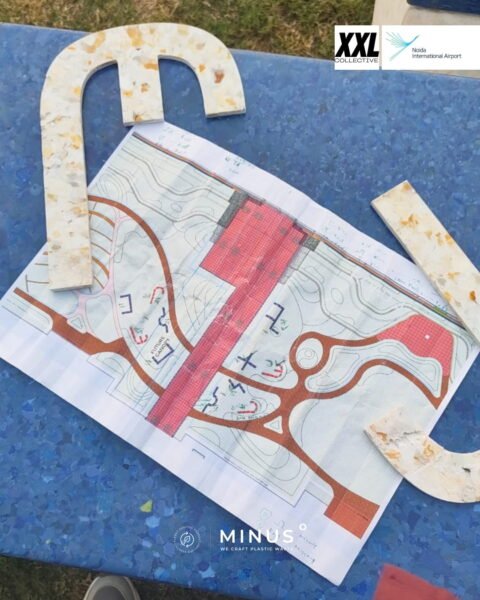
Minus Degre designed and manufactured 90+ custom seating modules and two information plaques for the airport’s Arrival Zone.
The seating modules use recycled polycarbonate waste, including difficult waste streams associated with automotive and electronic products. The project involved more than 13.5 tonnes of waste material according to Minus Degre’s project documentation.
The significance is bigger than the number of benches.
This project demonstrates that recycled material can satisfy three requirements simultaneously:
Engineering
The material needs to survive a demanding outdoor public environment.
Design
The product needs to complement premium airport architecture.
Sustainability
The product needs to create measurable waste-diversion impact.
That combination is what makes recycled infrastructure commercially relevant.
Recycled Benches Are Already Moving Beyond “Eco Products”
Minus Degre’s recycled benches have been positioned across CSR, institutional, public-space and corporate infrastructure applications, with projects and client engagements involving organisations such as:
- Feedback Foundation
- CDC
- HCL Foundation
- WEEE Foundation
- Plastic Fischer
- L&T
- Noida International Airport
These engagements demonstrate an important shift.
Recycled benches are no longer limited to small experimental sustainability projects.
They are increasingly being considered by foundations, corporates, infrastructure organisations and public-facing institutions as functional assets.
For CSR organisations, the proposition is particularly powerful:
Waste diverted → product manufactured → public asset installed → community uses it for years.
That creates a much more visible impact story than a one-time awareness campaign.
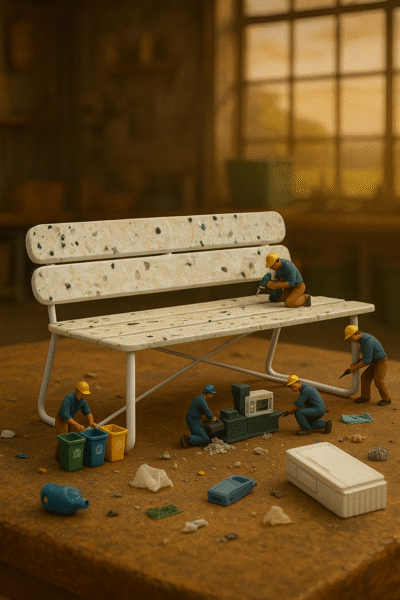
HCL Foundation: From Waste Management to Visible Infrastructure
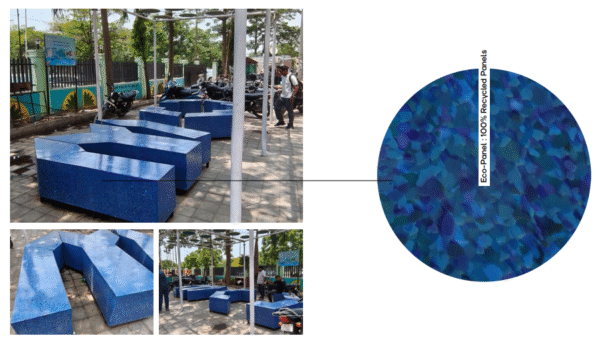
A strong example is Minus Degre’s work associated with HCL Foundation’s My Clean Project.
The project involved plastic-waste management and awareness, alongside the installation of recycled outdoor benches and recycled dustbins.
Minus Degre reports 1,500 kg of plastic waste recycled through this project.
The model is important because the final output is not simply recycled material.
It is public infrastructure with an environmental story attached to it.
A person can see the bench.
Sit on it.
Use it.
And understand that it was created from waste.
That is the power of visible circularity.
Why Organisations Choose Recycled Benches
Across CSR and institutional projects, the decision is increasingly driven by five factors.
1. Measurable waste diversion
The amount of recycled material can be quantified.
2. Long-term visibility
Unlike a temporary campaign, the product remains in the community.
3. Low maintenance
Outdoor recycled plastic can reduce the recurring painting, polishing and anti-rust requirements associated with some traditional materials.
4. Sustainability storytelling
The product itself communicates the organisation’s environmental commitment.
5. Customisation
Benches can be designed around specific locations, colours, dimensions, branding and architectural requirements.
This combination makes recycled furniture particularly suitable for CSR and ESG-led infrastructure projects
.
The Adoption Barriers Nobody Talks About
The recycled-material market is growing.
But it is not frictionless.
There are genuine barriers that need to be addressed if recycled plastic is going to become mainstream infrastructure.
1. Feedstock consistency
Waste is not a uniform raw material.
Virgin plastic comes with predictable specifications.
Post-consumer waste does not.
A manufacturer therefore needs robust:
collection → segregation → cleaning → processing → quality-control
systems.
2. Upfront material cost
Recycled material is not automatically cheaper than virgin material.
In fact, difficult waste streams can sometimes be more expensive to collect and process because they require:
- Segregation
- Cleaning
- Sorting
- Material preparation
- Specialised processing
- Quality control
The economic advantage therefore has to be evaluated over the entire product lifecycle, rather than comparing only the raw-material price.
3. Standardisation
This is one of the biggest barriers in government and institutional procurement.
Traditional materials often have established specifications and familiar tender language.
Recycled materials may require buyers to specify:
- Recycled-content percentage
- Polymer type
- Mechanical properties
- Weathering performance
- Fire performance where applicable
- Load capacity
- Dimensional tolerances
- Test standards
- Warranty
- End-of-life pathway
Without standardised specifications, procurement teams may hesitate to adopt new materials.
The Solution: Performance-Based Procurement
Instead of writing a tender around:
“Wooden bench”
or
“Metal bench”
future procurement can increasingly specify:
Outdoor public seating meeting defined structural, durability, weathering, safety and dimensional performance requirements, with a minimum recycled-material content.
This approach creates room for material innovation while keeping performance requirements non-negotiable.
It also allows governments and infrastructure developers to compare different materials on performance rather than tradition.
Why Architects Need a Recycled-Material Datasheet
For serious architectural and infrastructure projects, a brochure is not enough.
A recycled-material manufacturer should be prepared to provide:
- Material composition
- Recycled-content percentage
- Density
- Tensile properties
- Flexural properties
- Impact performance
- Water absorption
- UV/weathering information
- Dimensional tolerances
- Load capacity
- Installation details
- Maintenance requirements
- Expected service life
- Warranty
- End-of-life/recyclability information
This is how recycled materials move from “sustainable products” into the professional specification ecosystem.
The future buyer will not ask only:
“Is this recycled?”
They will ask:
“Show me the data.”
Recycled Plastic Does Not Mean One Material
One of the biggest mistakes in the industry is treating “recycled plastic” as a single category.
It isn’t.
A recycled-HDPE bench, recycled-PP bench and recycled-polycarbonate bench can have very different properties.
Likewise, a product manufactured from a controlled single-polymer waste stream can behave very differently from a product made from mixed plastic waste.
For this reason, procurement documents should always identify the actual material system.
At Noida International Airport, for example, Minus Degre used recycled polycarbonate waste rather than treating generic mixed plastic as the raw material.
That distinction matters.
Why Recycled Polycarbonate Is Particularly Interesting for Premium Infrastructure
Polycarbonate is an engineering thermoplastic known for:
- High impact resistance
- Good dimensional stability
- High strength-to-weight performance
- Transparency in virgin applications
- Weathering potential with appropriate stabilisation
- High-performance engineering applications
Using recycled polycarbonate introduces an additional challenge:
maintaining material consistency after the recycling process.
That is where manufacturing expertise becomes critical.
A recycled material is only as good as the system used to process, formulate, test and manufacture it.
This is why the future of recycling is not simply about collection.
It is about material engineering.
From Bench Manufacturer to Material Company
This is the larger opportunity for Minus Degre.
The recycled bench is the visible product.
But behind it sits a much larger capability:
Waste collection → material development → processing → sheet/material manufacturing → product design → infrastructure manufacturing.
That vertically connected model allows difficult waste streams to be converted into higher-value applications.
And the same material platform can potentially produce:
- Benches
- Tables
- Planters
- Signage
- Information plaques
- Outdoor furniture
- Architectural panels
- Landscaping products
- Public-space installations
- Interior products
The opportunity is therefore not simply:
“How many benches can we sell?”
It is:
“How much infrastructure can we build from waste?”
The Future of Railway & Airport Furniture
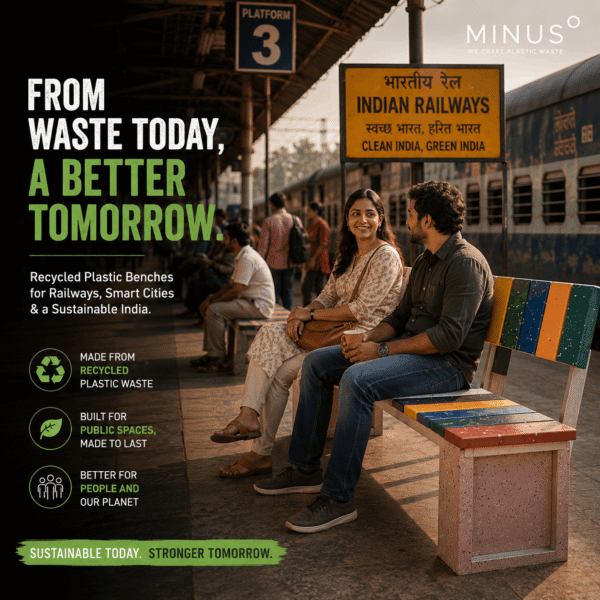
Railway stations and airports will increasingly become showcases for sustainable materials.
Consider the visibility of these spaces.
Millions of people pass through them.
That creates an extraordinary opportunity for infrastructure to communicate sustainability.
A bench can carry a simple message:
“This bench contains 60 kg of recycled plastic waste.”
Suddenly, recycling becomes tangible.
A passenger does not need to read a sustainability report.
They can see the result.
Why This Matters for Smart Cities
A smart city is not defined only by digital technology.
It is also defined by how intelligently it uses resources.
That means:
Smart waste management
should connect with
Smart material manufacturing
which should connect with
Smart public infrastructure.
Instead of exporting waste out of the city and importing virgin materials back into the city, cities can increasingly explore local circular systems.
Plastic waste can become:
collection → recycled material → bench → public space → long service life → future recycling.
That is a genuinely smarter material economy.
The Business Case: Sustainability + Lifecycle Economics
The cheapest product to purchase is not necessarily the cheapest product to own.
For public infrastructure, buyers should consider:
Initial cost + installation + maintenance + repainting + repair + replacement + disposal.
A recycled plastic bench can become commercially attractive when its low-maintenance characteristics and long service life offset its initial material or manufacturing premium.
The business case therefore needs to move from:
“What is the purchase price?”
to:
“What will this asset cost over 10–20 years?”
That is the conversation that will unlock larger institutional adoption.
The Next Phase of India’s Recycled Infrastructure Market
The first phase of recycling was about collecting waste.
The second phase was about processing waste.
The next phase will be about:
Designing with waste.
That means developing materials that architects can specify.
Products that governments can procure.
Furniture that cities can deploy.
Infrastructure that airports can trust.
And systems that companies can use to demonstrate measurable ESG and CSR impact.
Recycled benches are one of the clearest entry points into this future.
They are simple enough to understand.
Visible enough to demonstrate impact.
And technically demanding enough to prove whether recycled materials can truly perform.
The Real Test of Sustainability Is Performance
A sustainable product that fails after two years is not sustainable.
A recycled product that requires excessive maintenance is not automatically sustainable.
And a product labelled “eco-friendly” without measurable recycled content or performance data should not be treated as a serious infrastructure solution.
The future belongs to products that can demonstrate all three:
1. Environmental impact
How much waste was diverted?
2. Engineering performance
How strong, durable and weather-resistant is the product?
3. Commercial viability
What does it cost to buy, maintain and operate over its useful life?
That is the standard recycled infrastructure should be held to.
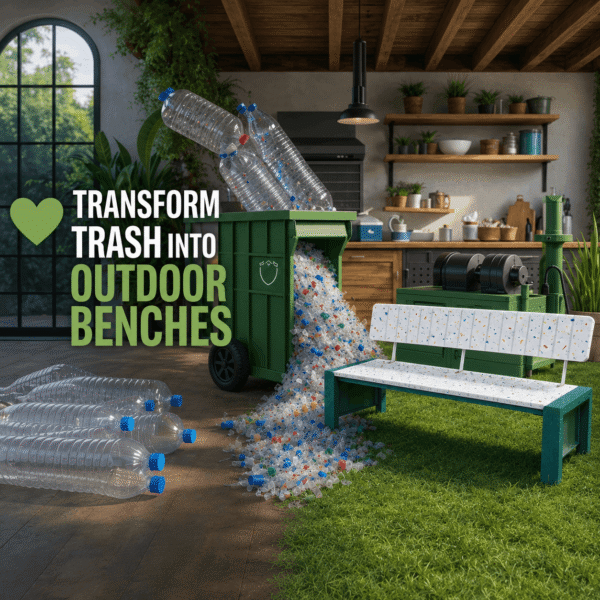
From Plastic Waste to Public Infrastructure
The most exciting part of this market is that the transformation is visible.
A piece of plastic waste begins as something nobody wants.
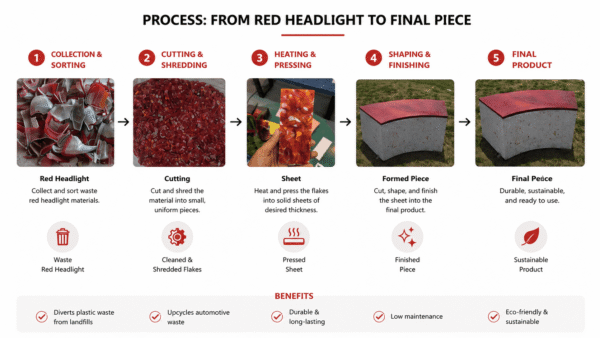
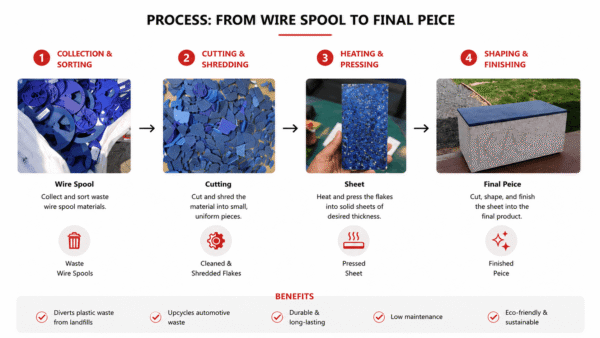
Through collection, processing, material engineering and design, it becomes a product.
That product becomes a bench.
The bench becomes infrastructure.
And the infrastructure becomes part of everyday life.
At Noida International Airport, more than 90 seating modules demonstrate this journey at one of India’s newest major aviation projects.
Across CSR and institutional work involving organisations such as Feedback Foundation, CDC, HCL Foundation, WEEE Foundation, Plastic Fischer and L&T, recycled benches are becoming part of a broader story of converting waste into useful, visible public assets.
The message is simple:
Recycling should not end at material recovery. It should end with something valuable.
Conclusion: The Bench Is Only the Beginning
The recycled plastic bench may look like a small piece of public infrastructure.
But it represents a much larger transformation.
India has:
millions of tonnes of plastic waste.
It also has:
millions of square metres of infrastructure being built.
The opportunity lies in connecting the two.
That requires better recycling technology.
Better material engineering.
Better product design.
Better testing.
Better procurement standards.
And manufacturers capable of delivering at scale.
For architects, the opportunity is to specify materials differently.
For governments, it is to create performance-based procurement frameworks.
For CSR teams, it is to turn waste management into visible community infrastructure.
For infrastructure developers, it is to reduce dependence on linear materials.
And for companies like Minus Degre, the mission is bigger than manufacturing benches.
It is to prove that waste can become a serious industrial material.
Because the future of sustainable infrastructure will not be built only from what we extract from the earth.
Increasingly, it will be built from what we choose not to throw away.
From plastic waste to benches.
From benches to infrastructure.
From infrastructure to a circular India.
The future is not just recycled.
It is designed.